Health and Safety Policy for Landscaping Shoreditch
 This health and safety policy sets out the standards and responsibilities that guide all landscaping Shoreditch activities. It applies to site preparation, planting, lawn care, hard landscaping, maintenance, waste handling, and the use of tools and machinery. The aim is to protect workers, clients, contractors, and members of the public by reducing risks through careful planning, clear communication, and consistent supervision. Safety is not treated as an optional extra; it is built into every stage of the work.
Our approach is based on identifying hazards early, assessing the level of risk, and putting sensible controls in place before work begins. Every project is expected to be carried out with safe working practices and a strong focus on prevention. Team leaders must make sure that tasks are assigned only to people who are suitably trained and physically able to complete them. Equipment must be suitable for the job, properly maintained, and used only in accordance with manufacturer instructions and site procedures.
 We recognise that landscaping work can involve changing ground conditions, sharp tools, moving vehicles, power equipment, manual handling, dust, noise, and exposure to weather. These hazards require ongoing attention. Before any task starts, a site-specific risk assessment should be completed and reviewed whenever conditions change. Particular care must be taken where work takes place near the public, around uneven ground, or where materials may create trip, cut, crush, or impact risks.
All employees and subcontractors are expected to follow instructions, wear the required personal protective equipment, and report unsafe conditions immediately. Appropriate PPE may include safety boots, gloves, eye protection, hearing protection, high-visibility clothing, and weather-appropriate outerwear. PPE does not replace safe methods, but it is an important last line of defence. Where additional protection is required for specific tasks, it must be provided and used correctly.
Manual handling is a significant part of landscape maintenance and installation work. Loads should be assessed before lifting, and heavy or awkward items should be moved using team lifting, mechanical aids, or better planning rather than force. Repetitive activities should be rotated where possible to reduce strain. Workers must be encouraged to speak up if they feel a task is beyond their capability or if the load, access route, or terrain makes the job unsafe.
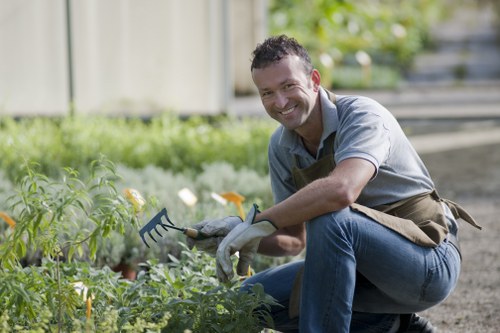 Tools, machinery, and powered equipment must be inspected before use and kept in a safe condition. Defective items must be removed from service immediately and reported. Only trained and authorised personnel may operate cutting equipment, compactors, grinders, or other powered tools. Guards and safety features must never be bypassed. Fuel, batteries, and electrical items should be stored and handled in a way that reduces fire, shock, and leakage risks.
Good site housekeeping is essential to safe landscaping services. Work areas should be kept tidy, with materials stacked securely and waste removed regularly. Slips and trips are prevented by managing hoses, cables, debris, wet surfaces, and loose materials. Access routes should remain clear for workers and emergency access. Where work is being done close to roads, entrances, or shared spaces, barriers, cones, and warning signs should be used as needed to protect others.
Environmental conditions can affect safety throughout the year. Hot weather may increase the risk of dehydration and fatigue, while cold, rain, wind, or poor visibility can make surfaces slippery and reduce control of tools. Work should be adjusted when conditions become unsafe. Rest breaks, drinking water, suitable clothing, and additional supervision may be required. In the same way, darkness or low light should trigger better illumination and a reassessment of whether work can continue safely.
First aid arrangements must be in place on every relevant site, and workers should know how to raise an emergency promptly. A suitable incident reporting process helps ensure that accidents, near misses, and unsafe conditions are recorded, investigated, and used to prevent recurrence. The business will review incidents, update controls where necessary, and maintain a culture in which concerns are treated seriously. Safe landscaping depends on learning from experience and improving procedures over time.
Responsibilities and Control Measures
 Management is responsible for providing competent supervision, suitable equipment, and adequate training. Supervisors must monitor work activities, enforce safe systems of work, and stop work if conditions become unacceptable. Workers are responsible for cooperating with safety arrangements, using equipment correctly, and protecting themselves and others from harm. A shared commitment to health and safety in landscaping helps create a reliable and professional working environment.
Training, Communication, and Review
Training should cover tool use, manual handling, site hazards, emergency response, and the specific demands of each task. Communication must be clear, especially when work is taking place across multiple teams or when activities change during the day. This policy will be reviewed regularly to make sure it remains current, practical, and effective. Updates may be made following incidents, changes in work methods, or new risk information. Continuous improvement is essential to maintaining a safe and responsible service.
 By applying this policy consistently, landscaping Shoreditch operations can be carried out with professionalism, care, and respect for everyone involved. Safety, planning, and accountability are the foundations of every successful project, and all work must support that principle.